
On this page
- Which buildings need commercial gutter work?
- How is a commercial system different?
- Why does Abilene weather matter for commercial roofs?
- What does a commercial gutter job include?
- Maintenance on a schedule
- What should a property manager ask?
- How are large roofs sized?
- What causes most commercial gutter failures?
- What should a maintenance plan include?
- Related services
Which buildings need commercial gutter work?
Across Abilene and the Big Country, commercial gutter calls come from:
- Retail strips and offices along the main corridors, where downspouts discharge onto parking lots and walkways.
- Churches and schools, with tall walls, big roof planes and entrances that must stay dry.
- Apartment complexes, where one problem repeats across many buildings.
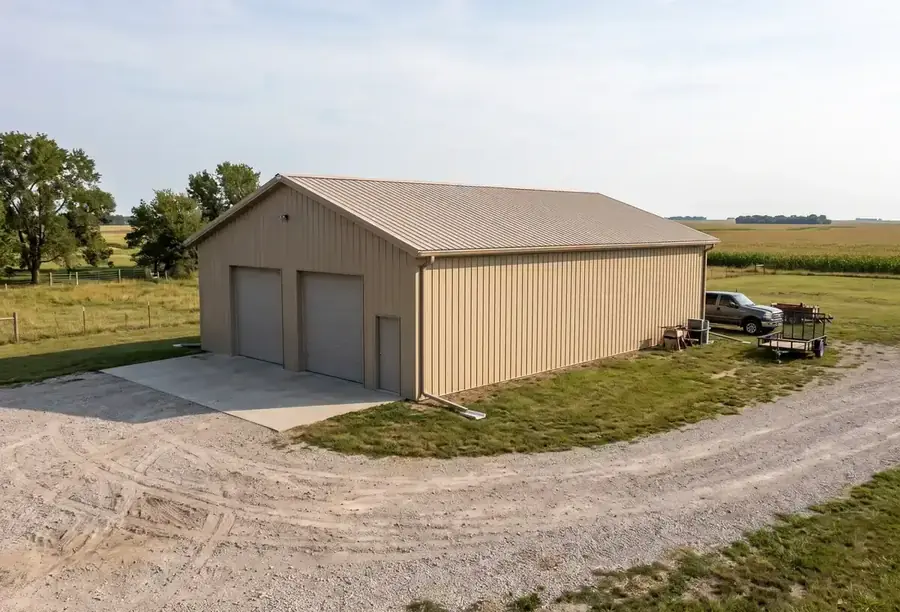
- Metal buildings and shops, common in towns like Merkel, Clyde and Anson, where long steel roof panels shed water fast.
- Historic downtown buildings in Downtown Abilene, where parapets, built-in gutters and scuppers need careful repair.
How is a commercial system different?
| Element | Residential | Commercial |
|---|---|---|
| Gutter size | 5-inch or 6-inch K-style | 6-inch to 8-inch K-style, box or custom profile |
| Downspouts | 2x3 or 3x4 | 4x5, 6-inch round or larger leaders |
| Flat roofs | Rare | Scuppers and conductor heads through parapets |
| Material | .027 to .032 aluminum | Heavier aluminum, galvanized or Galvalume steel, copper |
| Discharge | Lawn, splash block, buried line | Storm drain connection, site drainage, parking lot |
Sizing for a big roof is a calculation, not a guess. The roof area and the design rainfall intensity set the gutter and downspout size, following whichever plumbing or building code applies.
Why does Abilene weather matter for commercial roofs?
Big roofs collect a lot of water in a short storm. A 10,000-square-foot roof in a one-inch storm sheds over 6,000 gallons. Abilene's thunderstorms deliver exactly that kind of burst: in May 2019 the city saw an inch or more of rain on four days.
Hail and wind hit commercial buildings too. The June 2014 storm damaged roofs at Abilene Christian University and broke windows at Hardin-Simmons, and insured losses across the city reached an estimated $400 million. The May 2019 tornado damaged about 100 homes and businesses on the west side. After an event like that, gutters, downspouts and scuppers should be inspected with the roof.
What does a commercial gutter job include?
- Site visit. Measure runs, check roof type, parapets and existing drainage.
- Sizing. Calculate gutter and downspout sizes for the roof area.
- Access plan. Lifts, scaffolding or roof access, plus how entrances and parking stay safe.
- Fabrication. Seamless runs formed on site; box gutters and conductor heads made to measure.
- Installation. Heavy-duty hangers or straps, sealed joints, expansion joints on long runs.
- Discharge. Downspouts tied into site drainage or carried clear of walkways.
- Testing and handover. Water test and photos for your records.
Maintenance on a schedule
For property managers, a twice-yearly visit catches clogs and damage early: once in late fall after leaf drop, and once in early spring before the storm peak. Flat roofs with scuppers need the drains checked too, because a blocked scupper can pond water on the roof.
What should a property manager ask?
- How did you size the gutters and downspouts for this roof?
- What gauge and material are you quoting, and why?
- How will you keep entrances and parking safe during the work?
- Does the job need a permit, and who pulls it?
- Can I see a certificate of insurance, and may I call the insurer to confirm it?
- What maintenance schedule do you recommend?
How are large roofs sized?
On commercial work, gutters and downspouts are sized by calculation rather than by habit. The inputs are:
- Roof area draining to each gutter, measured on plan.
- Roof pitch, since steeper roofs catch more wind-driven rain.
- Design rainfall intensity, in inches per hour, for the location and the code in use.
- Gutter profile and size, which set how much water a run can carry.
- Number and size of downspouts, which usually limit capacity more than the gutter does.
The result is a gutter size, a downspout size and a maximum spacing between downspouts. On metal buildings, long smooth panels also call for snow-free, high-strength hangers and expansion joints on long runs, because steel and aluminum gutters move in summer heat.
What causes most commercial gutter failures?
| Failure | Usual cause |
|---|---|
| Overflow at one end | Too few or undersized downspouts |
| Ponding on flat roofs | Blocked scuppers or drains |
| Leaking box gutters | Failed lining or seams |
| Water at entrances | Downspouts discharging onto walkways |
| Torn-off runs | Light hangers on long, exposed eaves |
| Rust at seams | Debris and water sitting in steel gutters |
What should a maintenance plan include?
For a shopping strip, church, school or apartment complex, a written maintenance plan saves money:
- Twice-yearly cleaning, late fall and early spring.
- Scupper and roof drain checks on flat roofs.
- An inspection after every significant hail or wind event, with photos.
- A log of repairs by building and elevation.
- A list of downspouts that discharge near doors or walkways, checked after storms.
Related services
- Gutter replacement after hail or wind damage.
- Gutter cleaning on a schedule.
- Downspouts sized for large roofs.