
On this page
- What do gutter guards do?
- Which trees clog Abilene gutters?
- Which gutter guard types work best here?
- How much do gutter guards cost?
- Do guards stand up to hail and heat?
- What should be done before guards go on?
- Where do guards make the most sense?
- What should you ask about a guard?
- What do guards not fix?
- Related services
What do gutter guards do?
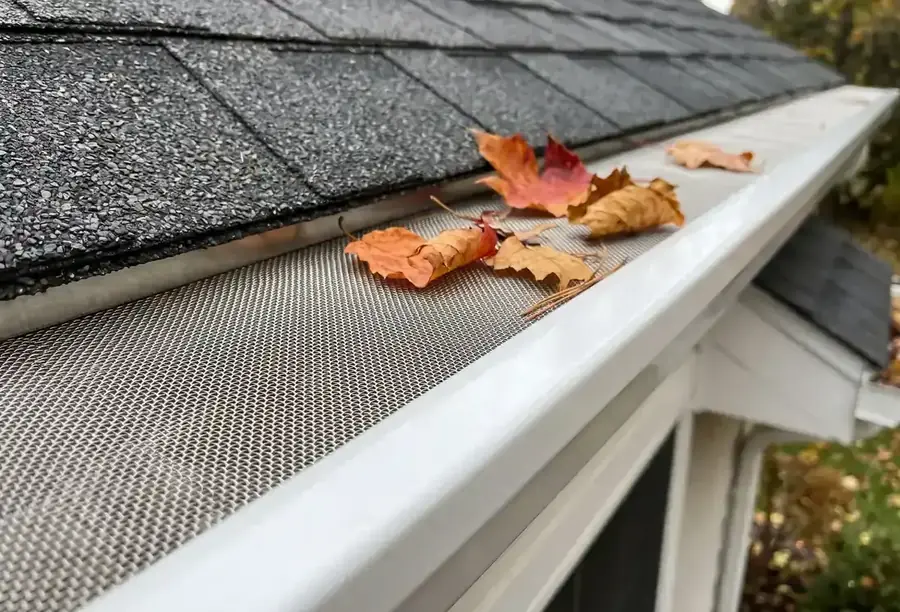
A gutter guard covers the top of the gutter so debris stays out while water gets in. The point is not cleaner gutters for their own sake. It is an outlet that stays open, so the next thunderstorm runs down the downspout instead of over the front edge and into the soil beside your foundation.
In Abilene the problem is less about a season of leaves and more about the moment a storm hits. Abilene's wettest months, May and June, come after spring wind has blown leaves, catkins, twigs and grit into the gutters. A blocked outlet in the first big storm of the year means the gutter does nothing at all when it matters most.
Which trees clog Abilene gutters?
A local guide to the best trees for the Abilene area lists red cedar, pecan, desert willow, Texas ash, mesquite and escarpment live oak, and older neighborhoods also have big cedar elms and hackberries. Each sheds something different:
- Pecans drop leaves, catkins in spring, and husks and nuts in fall. Husks are heavy and wedge into outlets.
- Live oaks look evergreen, but Texas A&M AgriLife notes they drop their old leaves in a short burst in spring, along with acorns. Small, tough leaves pack tightly.
- Mesquites shed tiny leaflets and long seed pods that lie flat in a gutter and mat together.
- Cedar elms and hackberries drop small leaves and seeds in fall that slip through coarse screens.
- Roof grit and blown dust wash off shingles after a dust storm and settle in the trough like sand.
Which gutter guard types work best here?
| Guard type | How it works | Strengths | Weak points |
|---|---|---|---|
| Micro-mesh | Fine stainless mesh on a rigid frame | Stops small leaves, seeds, grit and most dust | Costs more; mesh needs an occasional brush |
| Screens | Perforated aluminum or plastic sheet | Low cost, handles pecan and oak leaves | Mesquite leaflets and seeds slip through |
| Reverse-curve covers | Water follows a curved nose into a slot | Sheds leaves well, solid top | Can overshoot in a hard downpour; visible from the street |
| Foam and brush inserts | Fill the trough | Cheap, DIY | Trap grit, break down in sun and heat |
For most houses under mixed shade trees, a contractor will recommend micro-mesh. On a roof that only gets big leaves, a sturdy screen can be enough. See are gutter guards worth it.
How much do gutter guards cost?
Prices vary more for guards than for gutters. National guides put professionally installed guards across a wide range per foot, from inexpensive screens to premium micro-mesh systems, and HomeAdvisor's figures show the same spread. A house with 150 feet of gutter can cost a few hundred dollars for screens or a few thousand for a branded micro-mesh system. These are national ranges; ask for a written quote that names the product and how it is fastened.
Do guards stand up to hail and heat?
Hail is the hard test. The June 2014 storm dented roofs across north Abilene and downtown with baseball-size hail, and that kind of storm dents guards along with the gutters under them. Rigid aluminum or stainless frames hold their shape better than thin plastic, and screw-fastened guards stay put better in wind than snap-in ones. Plastic and foam products also break down faster under West Texas sun, where about 12 days a year reach 100 degrees.
If your gutters are part of a hail claim, ask whether the guards are listed too.
What should be done before guards go on?
Guards make a good gutter better. They do not fix a bad one. Before installation the contractor should:
- Clean the gutters and flush the downspouts.
- Check the pitch so water does not sit under the guard.
- Re-hang any sagging run and replace soft fascia.
- Repair or replace hail-dented or leaking sections.
- Confirm the downspouts discharge well away from the slab.
Where do guards make the most sense?
- Older neighborhoods with mature shade trees, like Sayles Boulevard and parts of North Abilene.
- Two-storey houses where every cleaning means a tall ladder.
- Houses with rain barrels, where cleaner water matters.
- Homes in tree-lined towns like Buffalo Gap and Baird.
What should you ask about a guard?
- What is the guard made of, and how is it fastened: to the gutter lip, the roof or the hangers?
- Will it stop pecan catkins, mesquite leaflets and roof grit?
- How does it handle a two-inch-an-hour downpour?
- What maintenance will it still need?
- Can it be removed and refitted if the roof is replaced after hail?
- Can I see a certificate of insurance and call the insurer to confirm it?
What do guards not fix?
A guard keeps debris out, but it does nothing for a gutter that is the wrong size, hung at the wrong pitch, or feeding a downspout that empties beside the slab. If your gutters overflow in a storm even when they are clean, the answer is bigger gutters or more outlets, not a guard. If water pools against the foundation, the answer is longer extensions. A contractor who recommends guards without looking at those things first is selling a product rather than solving a problem.
Related services
- Gutter cleaning before guards go on, or instead of them.
- Micro-mesh guards and screen and reverse-curve guards in more detail.
- Gutter replacement if the gutters need replacing first.