
On this page
What are the most common gutter repairs in Abilene?
| Problem | Usual cause | Usual fix |
|---|---|---|
| Hail damage | Large hail denting troughs, lips and downspouts | Replace damaged sections or runs, often with the roof |
| Wind damage | Gusts catching a loose end and bending the run | Straighten or replace, add hangers, check fascia |
| Leaking gutters | Cracked sealant at corners, end caps and seams | Clean and reseal, or replace corners |
| Sagging gutters | Loose or widely spaced hangers, heavy debris | Re-hang on hidden hangers every two feet |
| Downspout problems | Crushed elbows, clogs, short or missing extensions | Clear or replace, extend away from the slab |
| Fascia and soffit damage | Years of overflow soaking the wood | Replace rotten boards before rehanging |
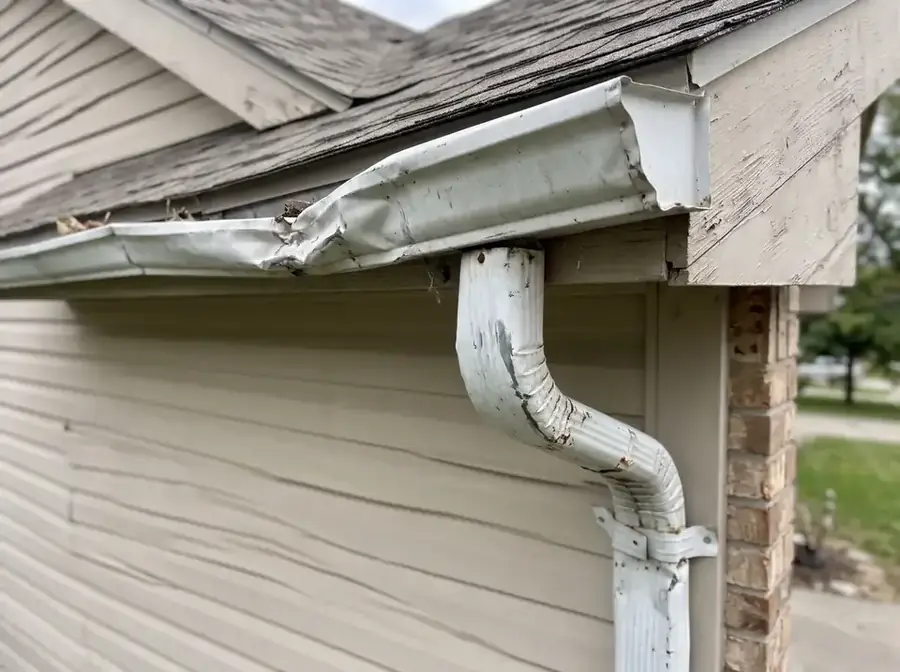
Dents, dings or split seams after a hailstorm
Large hail flattens the front lip of a gutter, dimples the bottom so water sits in low spots, and can crack corners and crush downspouts. Small dents are cosmetic; a run that now holds water or leaks needs repair or replacement. See hail damage.
Water pours over the front edge in a thunderstorm
Abilene's rain often arrives as short, heavy downpours. A 5-inch gutter under a large roof plane or a valley, a blocked outlet, or a run that has lost its slope will overflow. The outlet is cleared, the pitch checked, and the run upsized if needed. See 6-inch gutters.
A steady drip at a corner or end cap
Corners and end caps are the only joints in a seamless run, and summer heat bakes the sealant until it cracks. The joint is cleaned to bare metal and resealed, or the corner replaced if the metal has split. See leaking gutters.
A gutter sags, or has pulled away from the fascia
Hangers have loosened, are spaced too far apart, or are holding a gutter full of wet leaves and grit. If the board behind is soft, new screws will not bite until the wood is replaced. See sagging gutters and fascia and soffit repair.
A windstorm bent a run or tore it loose
Straight-line winds and gusts in spring storms catch the end of a gutter and peel it back. Kinks that hold water and torn hangers affect drainage even when the damage looks small from the ground. See wind damage.
Water pools against the foundation after rain
The downspout is discharging too close to the slab. On clay soil, a wet patch beside the foundation in a dry year is exactly what to avoid. See downspout repair and downspout drainage and your foundation.
Why do Abilene gutters fail?
Abilene gutters rarely wear out slowly. They tend to be damaged in an afternoon.
- Hail. Abilene has a long hail record. On April 24, 2011, a fire station two miles south of downtown reported 3.5-inch hail. On June 12, 2014, hail as large as grapefruit fell during a children's parade and art walk, with substantial damage downtown and on the east side.
- Wind. Severe storms and strong spring systems bring gusts that bend gutters. In March 2025 the city had peak gusts of 40 mph or more on ten days.
- Tornadoes. The May 18, 2019 tornado was rated EF2 and crossed the west side of Abilene, and news reports put the damage at about 100 homes and businesses.
- Heat. About 12 days a year at 100 degrees or more dry and crack sealant at the joints.
- Downpours. Gutters that keep up with a light shower overflow in a thunderstorm. Overflow soaks fascia, rots it, and loosens the hangers screwed into it.
How much does gutter repair cost?
National price guides put most gutter repairs in the low hundreds of dollars. Resealing a corner or rehanging a short run sits at the low end; replacing long sections, several corners or rotten fascia sits higher. If many repairs are needed at once, a replacement quote is worth comparing. These are national figures; the contractor's written quote is the one that counts.
What happens after a hail or wind storm?
- Stay safe. Keep away from any downed power line and call 911 if one is down or sparking. Keep people and pets clear of hanging gutter sections.
- Photograph everything from the ground: gutters, downspouts, fascia, roof edge, screens and any dents on vents or the A/C unit.
- Report the claim to your insurer before permanent repairs.
- Book an inspection. A contractor checks gutters, downspouts and the roof edge and writes up what needs replacing.
- Be careful who you hire. The Texas Department of Insurance warns that out-of-town contractors arrive quickly after a disaster. Hire locally where you can, get written bids, and avoid large up-front payments.
- Pay your deductible. It is illegal for a Texas contractor to offer to waive or absorb it, and your insurer may ask for proof you paid.
When is repair not enough?
Repair stops making sense when:
- Hail has dented most of the runs, not just one side.
- The gutters are old sectional pieces leaking at many seams.
- The same run keeps sagging because the fascia behind it is rotten.
- The gutters are too small, so they overflow even when clean.
- You are replacing the roof anyway.
See repair or replace gutters for a fuller checklist.
What should you ask before a repair?
- What is causing the problem, not just where is it leaking?
- Will this repair last, or will the same thing happen at the next storm?
- Is the fascia sound where the new hangers will go?
- If a section is replaced, can the new metal match the old color and profile?
- Can I see a certificate of insurance and call the insurer to confirm it?
- Can you put the repair and the price in writing for my insurer?
Related services
- Gutter replacement when repairs keep adding up.
- Gutter cleaning to clear debris before the storm season.
- Gutter guards if leaves and seed pods keep plugging the outlets.